
“A lot of people quit . . . I always knew I was never going to quit.” Sam Slocum is the embodiment of his own words. Earning a full-ride Division I scholarship, overcoming an ACL injury in 5 months, playing a second Division I sport, working in private equity, and running a sub-3 hour marathon doesn’t happen overnight. It happens from hours upon hours of showing up.
We see a guy who seems to always overachieve. What we don’t see is what happens behind the scenes: Sam pushing himself to break records in physical therapy, emphasizing weaknesses in training, waking up for long runs at 5 a.m. when he’d rather be asleep, and doing whatever it takes to put his team in the best position.
Sam’s story reveals the principles that guide success in elite fields.
Overcoming Hardships
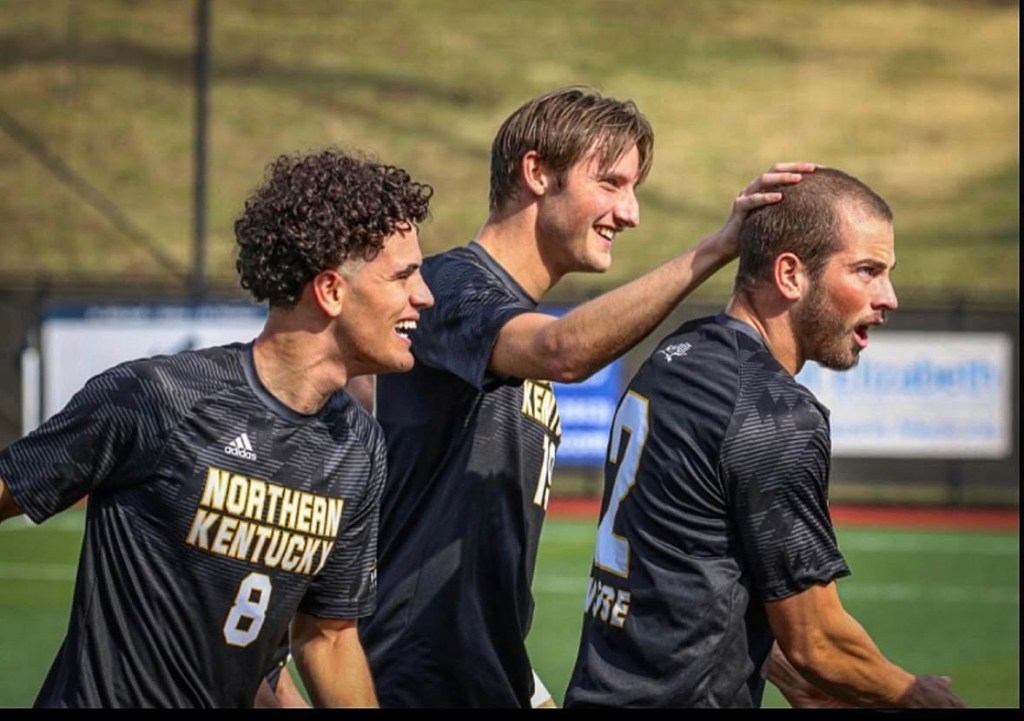
Coming off a freshman season at Northern Kentucky University where Sam played well, things were looking bright. He continued to get more comfortable in the system and was having a great off-season. He recalled, “Everything was falling into line. I was really stoked for my sophomore year.”
Then *pop*.
“I tore my ACL [and meniscus] playing summer league soccer going into my sophomore year. . . it was a whole reconstruction surgery,” Sam said. With one freak accident, Sam’s second season was over before it even started. All the momentum he built came to an abrupt halt.
He admitted it was tough. “It wasn’t fun. There were dark times. My identity had been as an athlete up to that point. It was where I spent all my time and focus. It was everything to me and it felt as if it just got ripped away. It was super tough mentally to swallow.”
But instead of sulking Sam “kinda went psycho in rehab.” He said, “I wanted to come back stronger than I had been before I tore my knee. Not only physically but also mentally” He added, “I was always constantly telling myself, ‘if they say do 10 reps of this execerise 15 will get me back quicker.’ I would even mess with the trainers, asking, ‘what’s the most reps someone’s ever done?’ I frankly think they would give me a fake number, but I would do it anyway.”
Sam recalled using mini competitions with himself throughout the process. He’d tell himself, “You did X amount of reps last week how many can you do this week? You ran on the water treadmill, now can you do the ultra g? Now can you get on the field?”
The lesson he learned? It takes showing up consistently to see results. He explained, “It was a slow process but it really taught me it’s not overnight success. It’s a bunch of tiny wins compounded over time. It’s not done in one day or just from one big win. It’s the consistent growth from just showing up everyday and putting your best foot forward.”
Being Well-Rounded
Sam didn’t begin his collegiate career with a full-ride scholarship. He had to earn it. He explained with soccer, earning a scholarship is different from some of the larger men’s sports like football and baseball. In a sport where scholarships are limited, teams can’t afford to miss on players. Therefore, they put greater emphasis on the entirety players.
“It’s not about how many stars you have like in football, there’s more to it than that. You have more ability to miss on a player when there’s ample scholarships at your disposal. In soccer, you’re investing in these people. You hope they’re a good representation of your program, you hope they’re a good representation on the field, and you hope they perform on the field,” he explained.
He added, “You work for what you get. It’s very limited so you have to be really creative or a hard worker and provide to the team more so than just ability on the field. Often ability is so much, but if your grades are terrible, they’re not going to fully honor that because it’s so limited.”
On the field being well-rounded means focusing on training your weaknesses. Sam admitted, “In all honesty, when it came to playing, I wasn’t the best at a lot of things. I was more persistent at working hard at things I knew I was bad at.”
He knew he had an edge over other guys when it came to natural athleticism. So he worked harder in other soccer-oriented areas. A big area of emphasis for Sam was communicating with teammates and staying engaged. Sam found, “I might not be the best at for instance say dribbling passed somebody, but I know I’m damn good at communicating to somebody if I’m gonna get them the ball where to go. And that’s how you stay engaged and learn.”
This persistence was fueled by a team-first mentality, “You don’t want to let your team down so you look internally or communicate with teammates and coaches where you have deficiencies and you try to work at those so that you can have that team moving in the right direction.”
Sam’s experience underscores that in the landscape of Division I athletics and specifically soccer, success isn’t just about what you can do, but who you are.
Evolving your Identity Past Athletics
[In a testament to Sam’s elite athleticism] he earned the opportunity to run track in his senior year at Northern Kentucky. This experience acted as a game changer for his identity shift and perspective.
He emphasized, “I’m so thankful I did it [ran track] because that rush when you’re going through the tunnel for the soccer game, during the national anthem, when you’re playing, when someone scores a goal, I was afraid I couldn’t get that somewhere else.”
But track gave him that “same rush adrenaline rush from being in the blocks.” He expressed, “It opened up my world to not just being in this small tunnel of soccer.”
Sam stressed, “Where you’re so regimented it’s easy to break. Everyone burns out . . . it even happened to me towards the end of my career. I needed something that brought my love back to sports and why I began playing in the first place.”
He expressed, “I started playing this on little pug soccer goals in the backyard. Track was the first time where I had a refresh where it’s like I’m doing this because it’s a challenge that I didn’t think you were capable of, but I took the leap of faith and did it. It was a big confidence booster.”
This experience allowed Sam to adapt to life after sports. He concluded:
It’s hard for people when their sport is over because it’s been their identity. You’ve been known as the athlete for years. You had all the notoriety when you were in high school. You had all the notoriety when you were in college and when you were a young kid. You have that built into that identity.
So I knew leaving it [soccer] I didn’t want to sulk and keep that as all I’m good for in my life. I wanted to it to be a chapter where I took a ton of learnings from and applied them to the next chapter of life.”
Realizing soccer wasn’t his identity allowed Sam to move forward in life after sports. It’s allowed him to enjoy the grind of private equity, running marathons, and having great relationships with friends.

Just Don’t Quit
Like many athletes, Sam’s journey included some high highs, but also some low lows. He was a captain at a Division I program, he started a lot of games, and he even won a club national championship in high school. But he also blew out his knee, recovered only for Covid to pause the season, and then needed hernia surgery just as the new season began.
He gave a candid response when I asked how he kept a level head through it all, “I wish I was better at that. The highs were great and the lows were tough. I wish there was a better way to stay levelheaded because it [Division I athletics] is an intense pressure cooker.”
What he did have was the mentality that no matter what the situation was, he would stick it out. To end the interview, Sam delivered an impactful quote:
“A lot of people quit. The thing that I always knew was that I was never going to quit. It was not in the cards. By doing so you kinda just keep showing up . . . I know I’m going to show up every day and that’s all I can ask for, and then inevitably I’m going to do the extra things off the field and hope it will prove dividends. And it did.
I think for anybody if you show up and put your best foot forward and that doesn’t just mean in practice – it means best foot forward in front of the coaches, best foot forward in front of your teammates, and best foot forward in school . . . you will reap the rewards. It might not be on your timeline, and it might not be tomorrow. But it might be in a year or two years. I didn’t plan for my ACL to tear, but then my whole senior year I played every game. I was happy that whole year, but it took time.
Staying the course means just keep showing up and giving as much effort as you can. If there’s anything I have to say about this whole thing it’s hard work always beats talent when talent fails to work hard any day of the week. You can be the most talented player but if you don’t keep working hard inevitably someone will outpace you.”
Sam didn’t let this mentality die when his collegiate career ended. Now, Sam focuses on endurance sports. In his first marathon, he finished in 4 hours and 45 minutes. But, he explained, “Instead of giving up, I reflected on my experience . . . After and a year a half of consistent training, I recently completed a marathon in 2 hours and 57 minutes.”
Now, it’s a different kind of hard for him, “No one wakes me up early to do this work; there’s no schedule like there was when I played competitive sports. I take pride in showing up day after day when no one is forcing me to. Each time I do, it feels like a personal victory.”
Though his playing days are over, the profound lessons cultivated in Division I athletics continue to define Sam Slocum’s life.


 The Players’ Corner
Leave a comment