
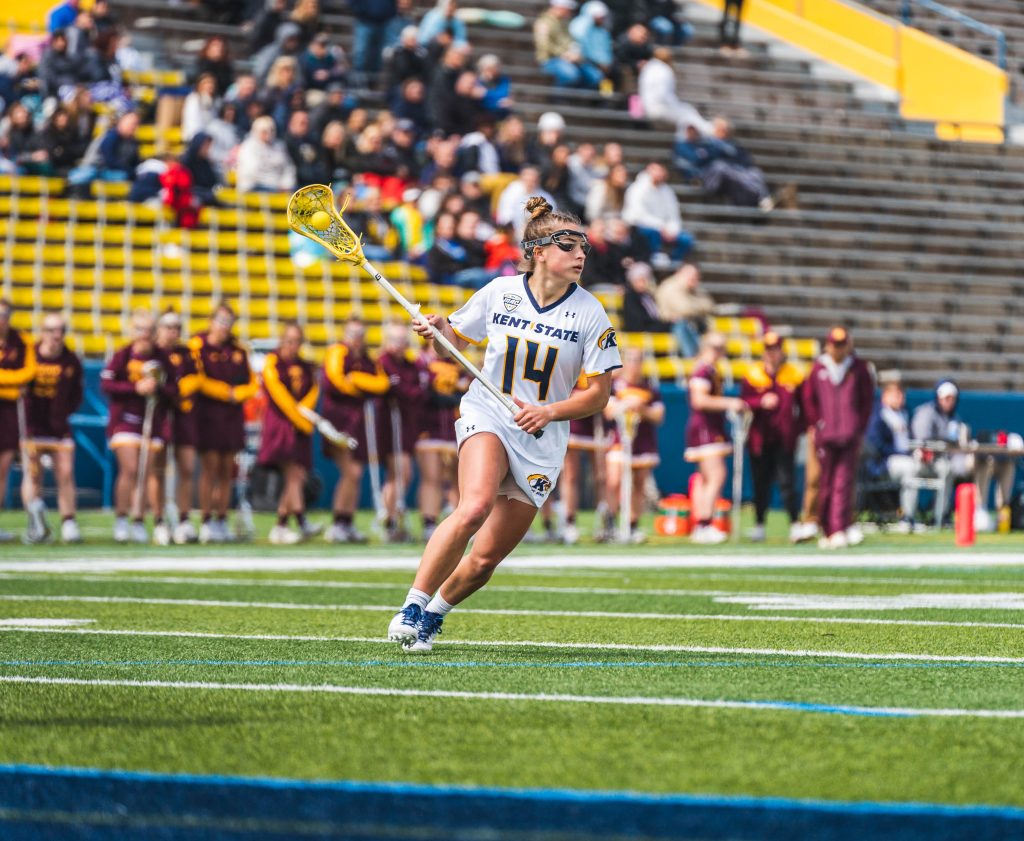
“I’m going to make you want to remember me,” a quote from Kenzie Sklar that makes it no wonder how she tied the conference record for goals in a single season.
Kenzie’s story is about grit. It’s about using setbacks as fuel to push harder. It reveals the unwavering mindset and self-made determination required to excel at the highest level of collegiate athletics and build a program from its very start.
This is how Kenzie became a Division I lacrosse star while leaving a lasting impact on the Kent State program.
Building from the Ground Up Through Self-Drive
Kenzie’s entire journey into collegiate lacrosse, from her training and recruitment to her experience at Kent State, was a testament to self-driven, ground-up construction. Kenzie expressed she had to learn a lot on her own, “I would watch Youtube videos, and I would go online to look up shooting form and how to get a faster shot. And I would go to Olentangy’s [her high school] field and do wall-balls for hours. It was self-motivation.”
Further, she didn’t have someone holding her hand through the recruiting process. Collegiate sports were unchartered territory for her family. Her club team didn’t receive a ton of attention. If Division I lacrosse was going to happen for her, it had to be her own doing.
While Kenzie’s family was incredibly supportive and excited by her collegiate ambitions, it wasn’t a process they were familiar with. Kenzie recalled, “My parents didn’t play. I don’t have family members that went through the recruiting process, learned how to reach out to coaches, or make film. It was all very new to me.”
When it came to club lacrosse, she described her team as being a “runt year.” The teams above and below her age group were higher caliber and received more attention. Kenzie said, “We kind of got left in the dust.”
Kenzie expressed, “It was like, ‘what do I do? I’ve never done this. I’m literally starting from zero.’ So I googled how to get recruited for college. I made my own film. They [her coaches] didn’t make my film. They didn’t reach out to coaches for me. It was all myself.”
Recruiting wasn’t the only time Kenzie had to build from the ground up. When Kenzie committed to Kent State it was a brand new program. She trusted in her coach’s vision and wanted to be a part of something special.
Kenzie recalled back to her recruiting visit at Kent, “When I toured as a junior, it’s not like I had teammates to say hi to or a locker room. She [Brianne Tierney, Kent State’s coach] was just like this is going to be our space, it’s not built yet. Here are the facilities that we’re using, but there was nothing that had lacrosse on it. There was no team to talk to, and there were no girls. You had to really envision a lot.”
Kenzie continued, “She [Tierney] said, ‘You’re going to be growing this. You’re going to be setting the example. You’re going to be the start.’ So there’s nothing for you to look at right now. Which was kind of intimidating and weird, but I kind of liked it.”
Kenzie embraced the challenge, something she did throughout her career.
Adjusting to College
Intensity immediately shifted from high school to college. The coaches had higher expectations and so did the classrooms.
Kenzie explained lacrosse’s intensity, “She [Tierney] expected a certain level of skill and motivation and grit . . . So it was a huge change freshman year. We practiced 6 days a week. We had two-a-days three days a week.” She added, “We were trying to build a foundation so if we didn’t have the best offense or defense, we wanted the best endurance and we wanted to be lifting the strongest.”
It wasn’t any easier for Kenzie off the field. For the nursing program, it was expected Kenzie would be studying at least 20-25 hours a week. And if she didn’t? Well, she risked not getting accepted into the nursing program because freshman year was pre-nursing. She couldn’t slack in the classroom. She had to take classes including chemistry, biology, and anatomy knowing a certain percentage of students get accepted into the program at the end of the year based on GPA.
“So I’m hearing this from athletics and this from academics and I’m like, ‘How am I going to do this and be on my own and have a college life?’ It was very overwhelming,” she shared.
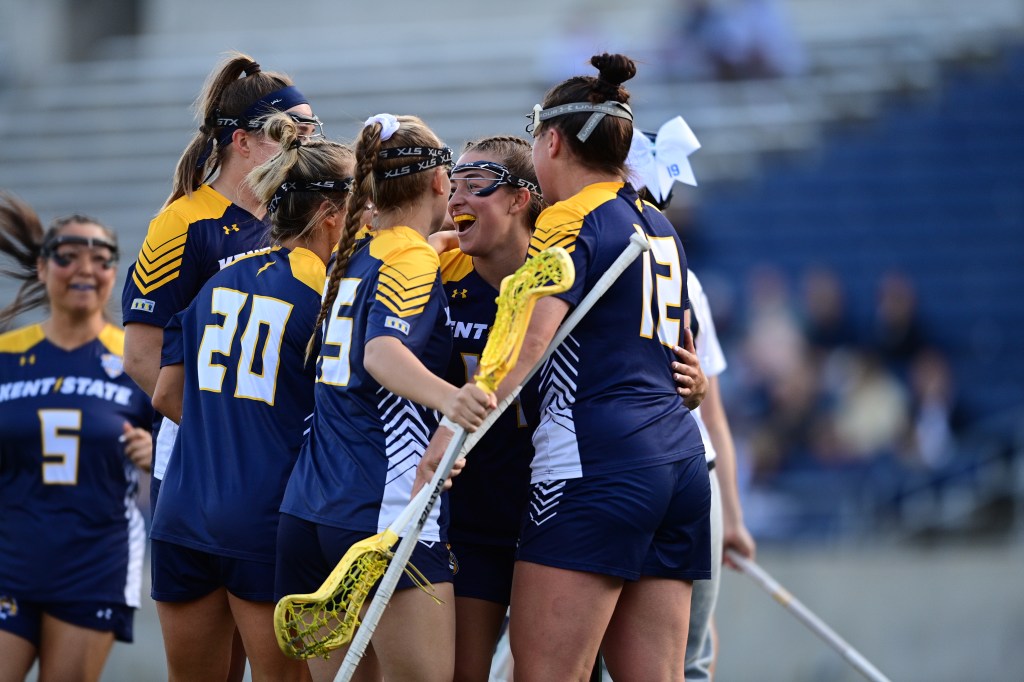
Enter her teammates. Kenzie praised her coach’s ability to find people that mesh and how this guided the adjustment. She said, “It’s so crazy to me because I have some of my best friends, even if we aren’t in the same city. They are my ride or dies and she [Tierney] handpicked those. Freshman year I got really close with my class. We were all in the same dorm building. And since we couldn’t have parties and go to bars, we would find ways to have fun and it made us really close. It was a good release from what we were experiencing adjusting.”
Having a Short-Term Memory
In Kenzie’s junior season, she dealt with some inconsistencies, “I would either score 5 goals in a game or only have one assist.” But her solution was simple, “It was stereotypical, but it was just realizing you gotta get over it and move onto the next one because if you don’t, and if you dwell on it, it’s just gonna carry into your next game and you’re going to be thinking about it over and over and over again.”
A habit from one of her former captains hit home for her. She explained, “She would do this thing she called her reset button. If she would do something bad, she would tap the end of stick like a button and that was it. That stuck with me.”
Kenzie didn’t use this exact method, but her mindset was the same. After a mistake, she’d tell herself, “You have two seconds to dwell on this, but if you look up, you’re in the middle of a game. You can’t be thinking about this, or else you’re gonna be forgotten or make another mistake. You made a mistake, but go prove you’re not going to make another one.”
Then after the moments, games, and seasons pass Kenzie would go back and analyze. She expressed, “I would look at my old stats, my old mistakes, and watch my film. I would rewatch stuff from the previous years to show how I should be growing. I would do that with my coach too. I would pull stuff from the year before when we would go into the fall and have a breakdown of, “This is what I did last year how can we change this year? What are some things I should be reaching for?”
Kenzie’s guidance for handling mistakes is clear. In the moment, let it go. Then when you’ve moved past it you can go rewind and learn from it.
Using a Chip on her Shoulder to Excel
Kenzie’s senior season was nothing short of spectacular. She logged 69 goals and 11 assists, tying the MAC record for goals in a season with her teammate. She never even scored fewer than two goals in a single game. She explained the season was fueled by an underlying chip on her shoulder.
In the second game of the season, the team had a full-circle moment. They were playing at Duquesne, a team that had beaten them 24-2 in a scrimmage Kenzie’s freshman year. Kenzie admitted that scrimmage had taken a toll on the team and left them feeling beat down. But this time it was different.
Kenzie shared, “It was a completely different team but a different mentality. We actually had a foundation. We had the numbers, we had the skill. And everything just clicked. We won, which was like a crazy full-circle moment and it started the momentum for the entire season because we were like, “Oh we’re good.”
It wasn’t just the team that played well against Duquesne. Kenzie tallied 6 goals and an assist, leading the team to a 16-15 victory. She expressed how that game carried momentum into the rest of the season, “It was the first good team that we had beat. It showed, ‘We are meant to be here and are a good team.’”
Kenzie didn’t just have a chip on her shoulder from freshman year results. After being a finalist for being a captain her senior year, she wasn’t selected. But this did not stop her from taking on a leadership position, “I took a step back and was like if I’m not a leader in that way how can I still be a leader?”
So how did Kenzie choose to be a leader? Scoring. She said, “I had to leave my mark on the program . . . I knew that going in it would be my last year of playing ever, and I wanted to really make it memorable.”
It’s safe to say Kenzie succeeded in her mission to make it memorable. Kenzie helped lead the team to their first conference championship in program history. She shared, “I had the best senior year personally, but also with my teammates and with my coach. Graduating it was the best way to end everything.”
When things didn’t go Kenzie’s way she responded with grit. She wasn’t from a prototype east-coast lacrosse state, she didn’t know how to get recruited, and she may not have been a captain on paper. But she did not let the adversities define her, she let them fuel her.

“I’m going to make you want to remember me.” And she did. Her story isn’t just about statistics; it’s about a self-made journey, where she consistently built her own path, transforming challenges into growth. Her lasting impact at Kent State stretches beyond goals and assists. Her self-drive, leadership, and grit serve as an infinite inspiration, building the program culture, igniting the ambition of future athletes, and challenging every individual to forge their own path.


 The Players’ Corner
Leave a comment