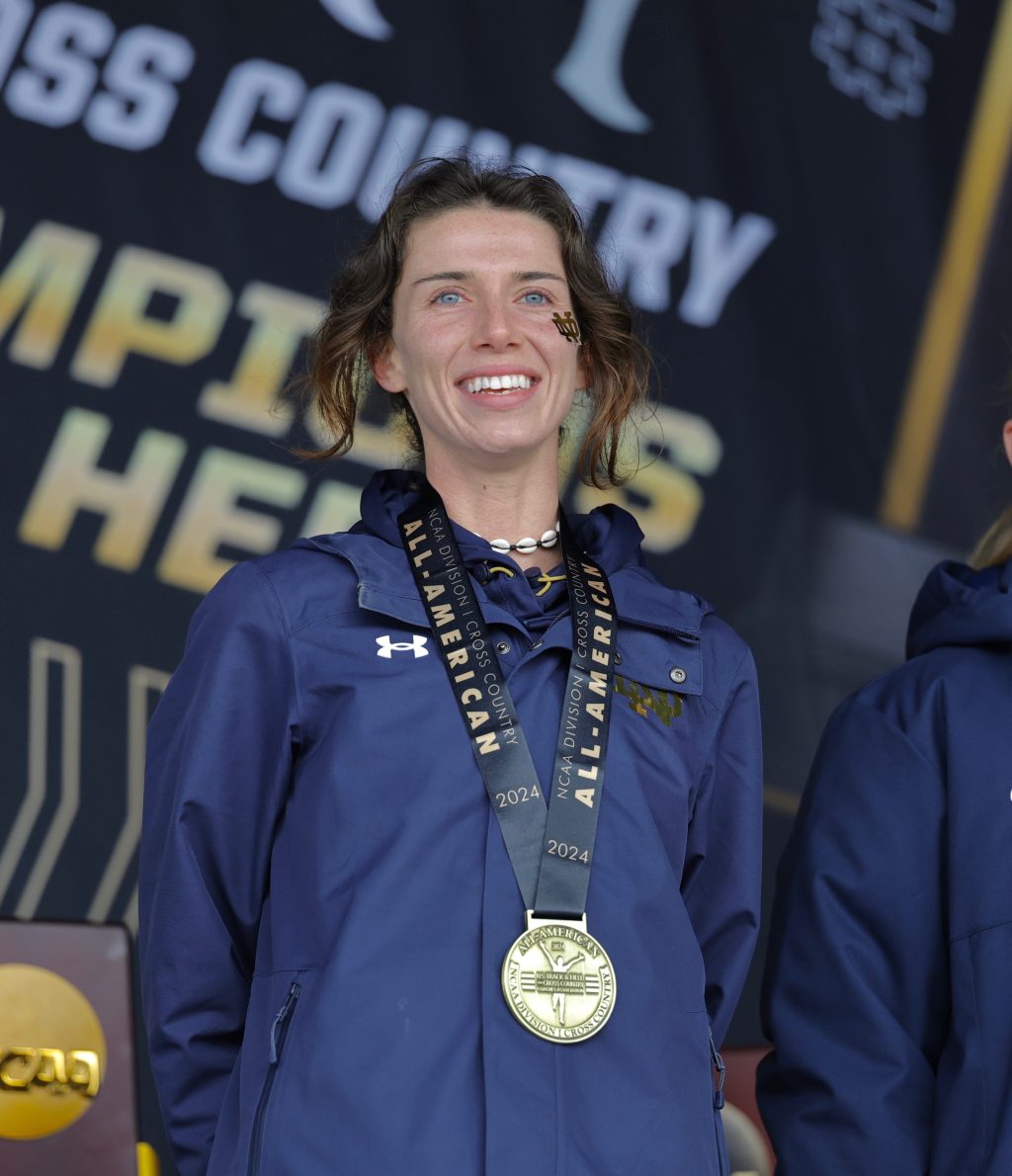
Forget the stereotypes of the typical flashy superstar athlete. When you talk to Erin Strzelecki, the Notre Dame All-American runner, you’ll find a grounded athlete whose quiet humility is her most surprising strength.
She didn’t come from a traditional sports background, and Notre Dame wasn’t even on her radar. Yet, it was this unassuming mindset and a genuine focus on the enjoyment of the sport that fueled her incredible ascent from an accidental runner to a collegiate powerhouse. She prioritized her teammates over herself, and it paradoxically led to her individual success.
Erin’s story isn’t just about running 55 miles a week; it’s a powerful blueprint for any athlete, or anyone chasing a big goal, proving how a humble approach can, against all odds, forge truly elite results and build a legacy that lasts.
The Unconventional Path to Notre Dame
You would assume a kid who grew up just an hour and a half away would be all in when the Fighting Irish’s coach comes calling. But not Erin. It wasn’t because of self-doubt or any negative views of the prestigious university, as she explained, “I didn’t realize my potential when I was just running like that just for fun.”
Erin credits this stress-free mindset for her success. She explained her interest in running began, “because I saw it as more of a social opportunity for me to make more friends, and that’s personally what I believe is the best way to get into something. . . Look at it as not something to initially to excel at, but look at it as this light-hearted fun, and nothing more than just for your pure enjoyment initially. And then if you excel at it, that’s the cherry on top.”
While her career began with intentions to socialize, excelling at it didn’t follow too far behind. Once she continued to improve a little, she started to entertain the idea of Notre Dame, but it still took convincing. Before Erin committed, she politely called the assistant coach and declined Notre Dame’s offer, but it didn’t take long for Notre Dame’s head coach, Matt Sparks, to call her back.
Erin expressed, “He called me back as soon as I got off the phone with the assistant coach. He sat me down and told me that I was worth them pursuing and that I needed to realize that.” She added, “And I finally realized that I am worth Notre Dame’s time, and Notre Dame is worth my time. And I took that more seriously and ended up going there. It was the best decision I’ve made. It was the best decision of my life. I would not trade for the world or any other opportunity in any other running program.”
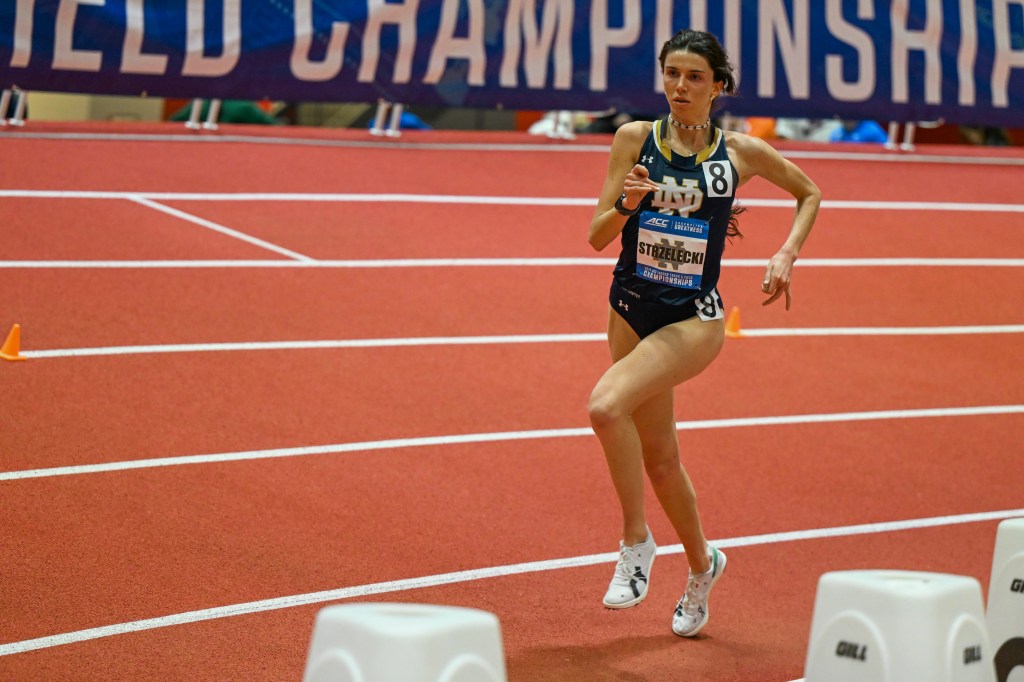
Her Approach to Training
You don’t reach All-American status without a disciplined, intense training program. And while it’s clear Erin trained at a high intensity, she knew when to take a step back and not push as hard. She understood the importance of recovery. And she knew how to be a “metronome.”
However, adjusting to collegiate training didn’t happen absent any setbacks. The adjustment presented some challenges for Erin her freshman year. And the issue wasn’t the mileage volume, rather it was the type of workouts.
Erin explained that in high school, her workouts often consisted of interval runs, but Notre Dame’s training emphasized tempo runs. While both are intense running workouts, interval runs include rest periods, while tempo runs mean running at a constant high-intensity steady pace.
Erin admitted, “For cross-country season those tempos were a slap in the face. And it was really difficult to hang on the train.” While difficult, it was not impossible, “But I was so fortunate to have a train to hang on and gained confidence by that. Even though I’d be really intimidated by that, what we had for that day, whether it was like a 3 or 4-mile tempo.”
It wasn’t just a train of her teammates in the fall season that helped Erin push through the tempo runs. In talking about leading up to the season she said, “I’d have to grab my dad or my mom or anyone who would bike with me for those tempos.”
Through the support of her teammates enduring the pain alongside her and Erin’s parents on bikes, she overcame the obstacle and now she even prefers the tempo runs, “Now that’s like a piece of cake I can do that whenever. I can go up to like 6 miles if we really wanted to or a 10-mile progression that’s great. I’ll take that over some of the interval work that we do because it’s so fast.”
Maturing as a runner also meant developing an understanding of when to push versus when to take a step back.
On her Monday easy runs, Erin didn’t mind if she got dropped from the group for going a little slower to promote recovery. And you can count on her to be a steady pacer, “You would not catch me throwing down a very fast pace at the beginning of a workout. I would yell, kindly, at people when they would do that.” She added, “I was the metronome of the group.”
Erin explained her development in mindset, “When I was in high school I was just like if I want to get faster, I just have to run faster. Just run faster on easy runs and run faster on longer runs. But, no you have to let your body recharge.”

A Team-First Mentality
Erin expressed how the team bond at Notre Dame went beyond individual times and even challenging race results, cultivating a family-like atmosphere where every runner felt valued, and collective support solidified them through every challenge and victory.
Even during grueling training sessions, Erin observed, the team’s support was constant. They knew the pain each other were enduring in their workouts, so they would “always cheer each other on because we all know that they’re hard. It’s kind of like the struggle that bonds us together.”
She added, “If I feel better and stronger when I’m being cheered on by my teammates, that’s most likely the same for the rest of everyone. So I would like to be treated that way, so I’m going to treat other people that way.” This mentality sums up Erin’s leadership. In times of struggle, it’s not just about her, but rather the collective.
This collective effort is what Erin gives credit to for her ability to endure through 10,000 meters (6.2 miles or 25 laps around a track) of race day effort. She said, “What calmed my nerves and settled me back into a racing mindset each 10k was ‘if my teammates can do it then I can do it.’”
This team-first mentality truly defined Erin’s approach, even at her individual peak. She recalled, “It was really bittersweet for me as well because I was able to achieve my personal goal of All-American again, which was really amazing, but I didn’t want to be honored for that because not all my teammates were being honored on the podium like I was.”
When Erin won her second-straight All-American honors in her final cross-country season at Notre Dame, she didn’t make it about herself. Instead, she cared about her teammates that came down with sicknesses before the race, preventing them from reaching the podium alongside her.
Knowing the immense guilt her teammates felt for not being at full capabilities, Erin immediately had their backs. She said, “We always reassured everyone after the race and it was a really great bonding moment for everyone that even at the end of the day if we don’t succeed or achieve our goals as a team, we are still going to be a team.”
In a moment that could have been about herself, Erin thought about her team.
Faith and Inner Strength
Even the toughest training runs and closest teammates can’t prepare an athlete for every challenge. For Erin, freshman year at Notre Dame brought not just new workouts but also the pain of injury, a true test of her strength. It was in these moments that Erin, rooted in her upbringing, relied on her faith for a sense of peace.
When she suffered plantar fasciitis her freshman year and found herself facing doubts, she would go to the chapel and pray. She said, “We always learned if you ever have any doubts or ever have any fears, just bring it to God at the altar. That’s how I always approached my faith. My faith just kind of surrounded everything I did.”
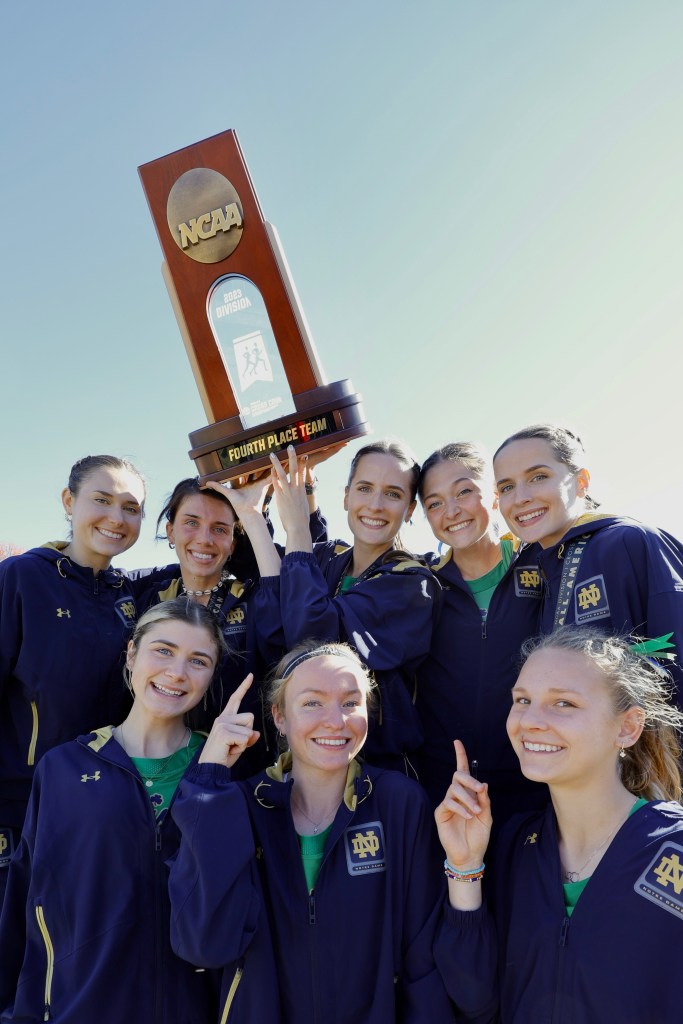
Ultimately, for all the accolades and achievements, the heart of Erin Strzelecki’s remarkable journey remains grounded in profound humility. Even now, the full weight of her Notre Dame experience is something she continues to process, a dream that echoes far beyond herself.
“It’s really humbling because I don’t think it’s completely set in for me that I went to the University of Notre Dame and graduated twice. It’s such a great dream that I’ve been able to fulfill. And my parents always say I wanna be like you when I grow up.”
In a world often fixated on individual statistics and spotlight moments, Erin Strzelecki’s career offers a refreshingly different definition of what it means to be an elite athlete. Her All-American status was undeniable, but her lasting legacy lies not just in the records she helped set, but in the humble spirit she embodied and the collective strength she championed. Her story is a compelling reminder that the most impactful achievements are often forged by those who prioritize connection over competition, and character above all else.


 The Players’ Corner
Leave a comment