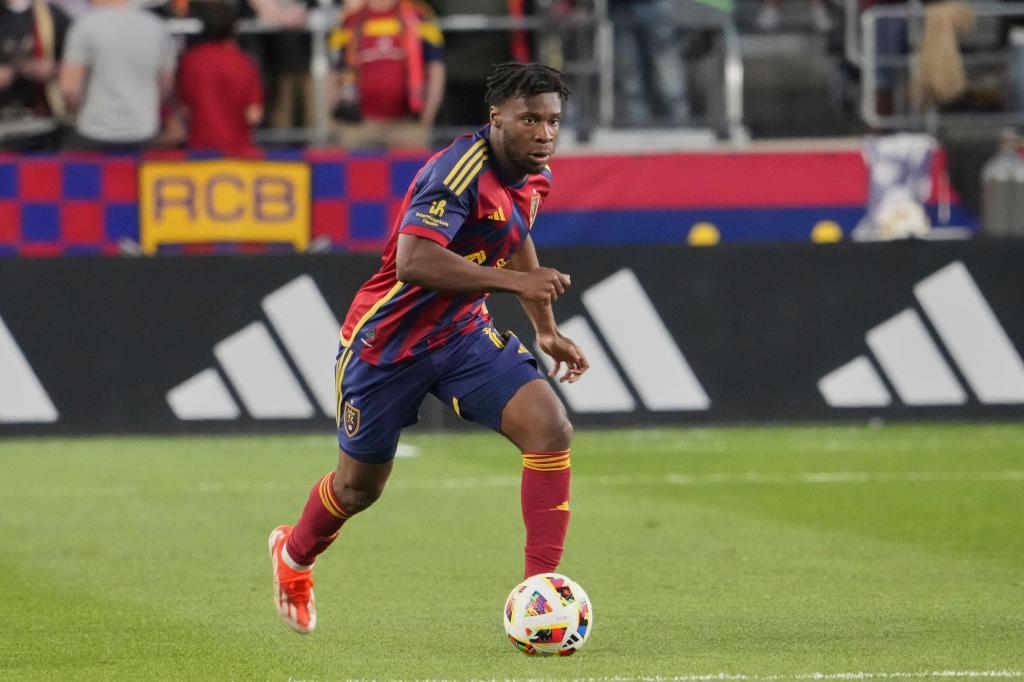
The current belief in American soccer says that college is a detour, not a destination. It’s an outdated pipeline, a path less optimal than securing a homegrown contract. Emeka Eneli is proving that belief wrong.
While other young stars made their professional debuts, he built a foundation at Cornell University that helped make him one of the best players in the MLS. His rise is an atypical one, but it signifies that your personal journey doesn’t need to follow convention; it’s about preparing yourself for your own challenges ahead, no matter how you get there.
The Untraditional Route: Graduating From College Rather Than Signing a Homegrown
A growing trend in Major League soccer is for players to sign “homegrown contracts” where players sign for a team after playing for its academy (Wright). Analysts claim the route to the MLS through the draft is outdated and that college is not the best “pipeline” to the pros (Wright). While college might not be the optimal path to the MLS currently, it didn’t stop Emeka from making it to the next level.
His coaches at Cornell helped him maintain the belief needed to get to the pros, as he said, “Something that really stuck out to me — what they said to me is, ‘A lot of people around you that you’ve played with are probably going to be signing homegrown deals, but everyone has a different path. So if you see them signing these deals, don’t get discouraged, just focus on your own path because it might come to you a year later, two years later, three years later, it’s just how things work out.’”
This guidance provided Emeka with a sense of relief. It allowed him to focus on his path, and not those of the guys he grew up playing with, as he shared, “That kind of took the pressure off of me thinking if I see this guy signing a homegrown… that I’m not good enough. I never thought that I was not good enough. I just thought that it’s not my time right now. Maybe I have a different pathway. As long as I keep working, then I’ll be able to have the chance and have my opportunity.”
While college may not be the perfect pipeline to professional soccer, he found it actually provided him with advantages that going straight from the academy would not have. He said, “When you’re in the academy, you’re like 15, 16, 17 [years old] and you’re growing up, but you’re not really facing tough things.” But when you get to college, “you’re kind of alone by yourself… if things aren’t going well, you really have to deal with that adversity by yourself without your parents or your family around you,” he added.
Facing adversity on his own, he learned how to overcome hurdles, as he explained, “Going through those four years, I kind of understood…that if things aren’t going well for me at the moment, it’s not the end of the world. I still have to keep my head down and grind.”
But for players making the jump straight from the academy, he thinks adversity can hit a little bit harder. He illustrated the risk of the situation, “A lot of those academy players…they’re the best players in their academy for all the four or five years they play. And so they kind of expect to jump straight into the first team and train with the first team right away.”
But he learned that when you’re playing older competition, even “a tackle can rock you” on day one of training and provide a wake-up call moment. It was easier for him to adjust to this level because at Cornell, he faced older competition and learned what it’s like to play at a non-youth level.
He detailed more specifically how college prepared him for this adversity:
I feel like if I didn’t go to college and experience things, not only on the field, but off the field — struggling with school, struggling with exams, struggling with how to manage my time — I would think that everything’s going to go in a straight, perfect line… But some of the ups and downs that I experienced in Cornell, when I had those here at Real Salt Lake, it was like, ‘It’s not the end of world. I can still work my way up to where I want to be.’ I just was able to deal with those things way better than I would have been able to if I were 18, 19 [years old].
And sure enough, when Emeka got to the professional level, he quickly faced adversity, “I got hurt before I even signed the first team deal… And then after that, I finally got healthy again; Then, they were playing me out of position at right back.” But when these obstacles hit him early, he wasn’t an 18-year-old yet to experience adversity; he was prepared.
Embed from Getty ImagesLearning Life as a Pro: Ongoing Adversity and Hyper-Fixation
In the midst of year three, Emeka is still learning on the go, but his experiences have brought ongoing lessons.
While he’s learned exponentially about how to tackle adversity, it’s an experience that’s always ongoing as an athlete. Currently, he’s adopted the mentality that “nothing is going to last forever… Things can change so fast. You could be out of the squad for two or three months, you come into the squad, you play two or three good games, then you could be starting for the rest of the season.”
He added, “You always have to have the outlook that the glass is half full. Things might not be going my way right now, but… all you really need is just a tiny, tiny bit of opportunity, a little sliver of a window to really perform and show your true ability, and then you never know what can happen.”
One of his biggest challenges at the professional level has actually come off the field. With the professional level being nearly double as many games as college, it’s been difficult to separate himself from the game. He’s found, “If you’re trying to focus on it 24-7… you’re going to be so worn out. Which is something that I have trouble with because I’m so hyper-fixated on the game.”
But he’s learned to stay away from the headlines on social media, find hobbies, and make time for family and friends. One way he can do all of these is by playing golf against someone who never seems to beat him, his brother. Golf has become one of Emeka’s favorite off-the-field hobbies. And while he chose his brother to be a part of his dream golf foursome, he mentioned he and his brother “love to do some friendly wagers, and he never beats me. He never beats me. We’re a similar level, and it’s always nice banter when we play.”
Ultimately, Emeka is still adjusting to life as a pro, but he’s discovering the holistic nature of the top-level, overcoming off-the-field and mental battles.
Emeka Eneli on the Field: A Humble Anchor
For Real Salt Lake, Emeka plays defensive midfielder, a position that lacks significant moments of glory. However, it’s a position that acts as an anchor for the team. While much of his work is winning the ball and distributing it, it plays right into his work ethic.
Emeka doesn’t find himself focused on the glory; rather, he’s just focused on “helping the team in any way.” He’s willing to chase down balls and be all over the field, even if it doesn’t lead to post-game headlines, and likely it’s this attitude that led to his team-voted MVP award in just his second professional season.
While he may not record goals and assists often, it doesn’t mean he never does. For instance, Emeka slotted a game-tying goal in the 2024 MLS Cup playoff game versus Minnesota, and he assisted on a goal for the United States versus Costa Rica. He admits that it’s a nice feeling to have these moments, but ultimately, he’s more focused on helping the team win.
Embed from Getty ImagesPlaying Without Pressure: Having a Cornell Education
As a Cornell graduate with a biological engineering degree, Emeka has an elite resume for life outside of soccer. He might have passed on a consulting job to pursue his professional dreams, but this doesn’t mean having the option didn’t help him.
He explained, “I think it kind of gave me the freedom to know that if I failed that I would have something to fall back on.”
He described with players who leave college after a year, “They don’t want to fail because they don’t really have a fallback option yet… So they really lay everything on the line.”
But for him, it’s different, as he said, “I do have a fallback option. It’s kind of a little bit less pressure on me. If things don’t work out, it’s not the end of the world… I can kind of just take the pressure off a little bit and enjoy it because you play your best when you’re enjoying the football.”
When the time comes for Emeka to hang up the cleats, he doesn’t want it to be the end of his time with sports, “I definitely want to stay around athletics… If I could somehow tie in my biological engineering to enhance performance… nutrition, recovery, things like that, I think that would probably be my go-to.” But for now, he’s focused on his playing career.
Embed from Getty ImagesMessage for Younger Players
Emeka is the perfect role model for young athletes, students, and players striving to combine the two. While his journey reveals a multitude of lessons, there’s one in specific that he sends to kids who look up to him:
“You should aim every single day, whether it’s training or a game or whatever you’re doing, aim to be better than you were the day before. No matter what happened the day before, if it was a bad day, if it was a good day, if you just focus on being a better version of yourself the next day, being one percent better the next day, then the amount of things you can achieve in two years, three years, four years is incredible. Because I think that the hardest part about anything — about life, about work, about soccer — is consistency. And the only way to get consistency is to continually try and be better than you were the day before… It can be a normal passing drill or a normal technical tactical drill, just checking your shoulder, things like that. Do it a little bit at a little bit of a higher pace, a little bit quicker. And I think that can take you a long way in anything that you’re trying to do.”
Emeka Eneli is proof that there isn’t one universal guide to success in soccer and life. He focused on his own path, not the journey of others, uniquely preparing him for the professional level in unexpected ways. He’s built a life foundation that allows him to enjoy the game he loves freely. He is an embodiment that if you keep your head down day by day, focusing on consistent improvement, you can reach your goals, no matter what route the crowd takes.
References
Wright J. Is playing College Soccer the best route to making the MLS? GMTM. https://gmtm.com/articles/what-percentage-of-us-soccer-players-play-professionally-in-the-u-s


 The Players’ Corner
Leave a comment