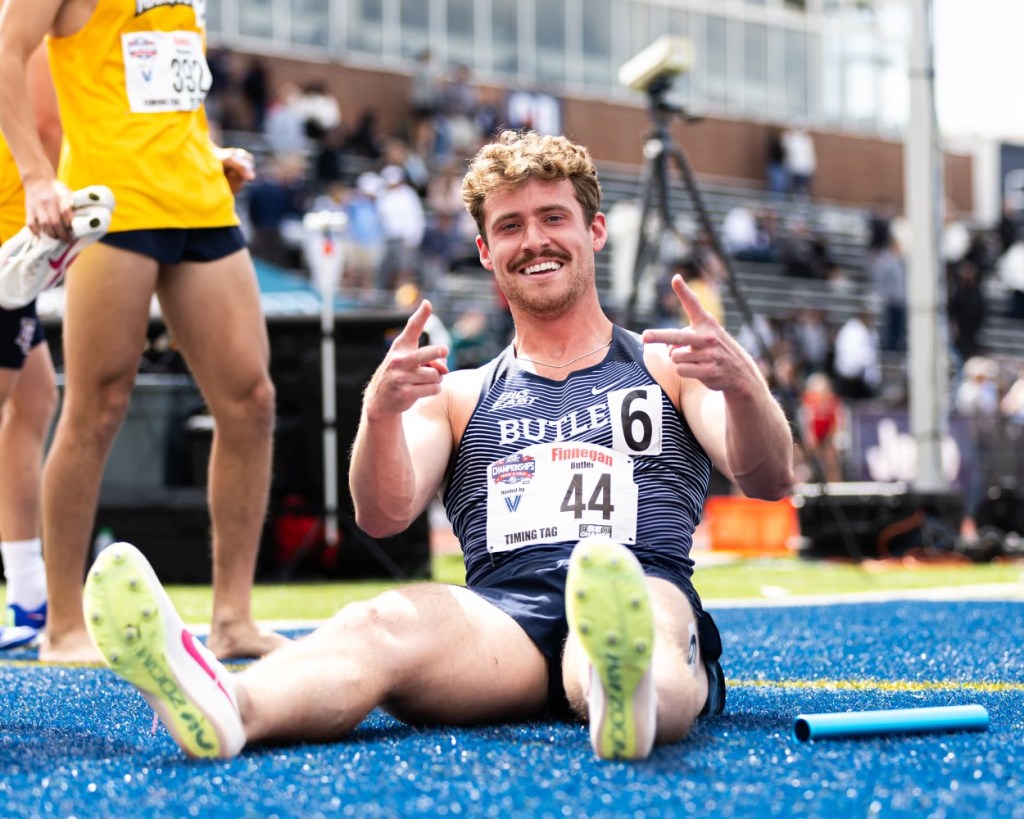
As Luke Finnegan prepared to anchor his 4×400 meter relay team in the biggest meet of the season, Luke had a singular mindset. He remembered, “There was no possible chance that I was gonna let him beat me. There was just no way.”
As the individual 2022 MAC champion and 2024 Big East Conference champion in the 200-meter dash, Luke cemented himself as one of the fastest athletes in the NCAA. Behind these results is how he evolved to acquire the confidence needed to match up against the best.
Turning a Focus Towards the Shorter Distances
In his high school days, Luke was a 400-meter standout, taking third on the podium in the Ohio state meet. His early success was no accident, as he remembered his profound intensity, “I just kind of put myself out there for the team in high school, and I took every 400 just like it was really like life or death.”
His approach and success in the 400 set the foundation for his collegiate career, as he said, “It’s what separated me in high school…that’s what I got recruited for.”
But in college, his speed found a new home: the 200-meter dash. The transition to the shorter race was largely the result of work off the track. With an increased emphasis on explosion in the weight room, Luke found he “had a lot more room to grow as a short sprinter.”
He realized with his improved explosion, paired with the potential to improve mentally as a short-distance runner, that he “didn’t even scratch the surface” of his potential.
By enhancing his training and learning from the coaches, Luke came to love and excel at shorter distances. While still being highly competitive in the 400-meter dash, his individual best collegiate results came in the more explosive shorter distances.
Recharging, Learning, Uncomfort, and Intentions
By Luke’s fifth and sixth years at Butler, he learned what it took to find success at the collegiate level.
One lesson being: freshman year can be unsustainable. He mentioned, “As a freshman, it’s always go, go, go… You go to class, you go to practice, you go to your friends, you get six hours of sleep, you repeat… a lot of freshmen can keep up with that. It’s a change of scenery. It’s exciting, but a lot of people get burnt out because of that.”
For him, he realized how important the social aspect of being on a team was. He found, “When you’re in a competitive environment, it’s a lot harder to step up to the challenge when you’re isolated, when you don’t have the social backbone.”
Socialization with the team helped him recharge his battery, helped him grow closer with some of his older teammates early on, and ultimately, helped him on the track.
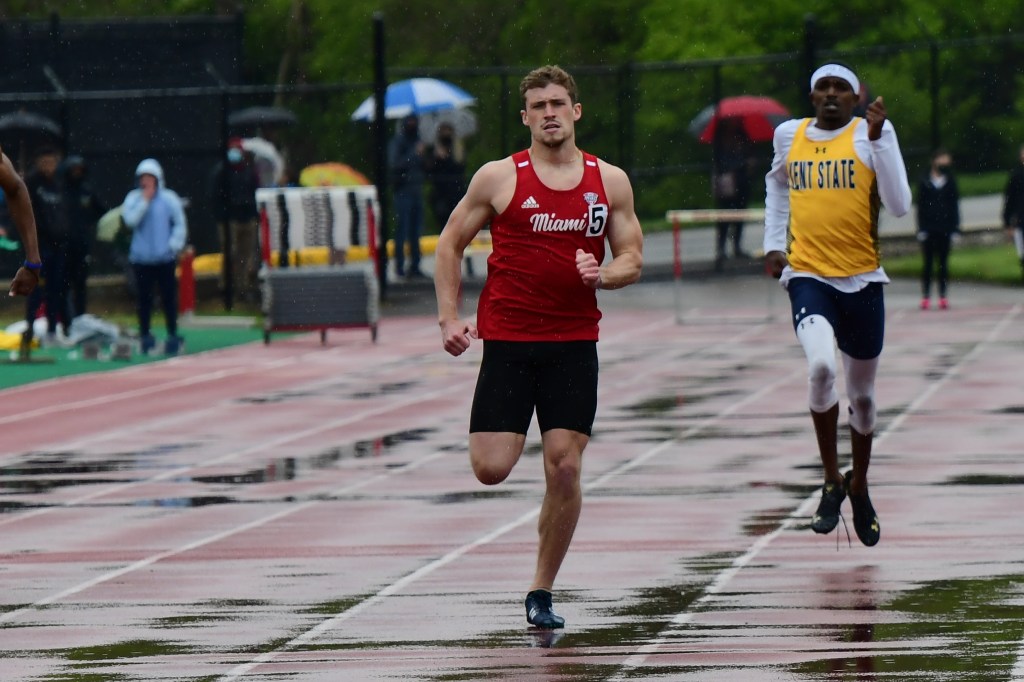
Another essential tool in Luke’s growth: curiosity. Luke recalled, “At Miami, it was a lot of learning for me. That’s where I became a better short sprinter because I had a coach who knew what he was doing, and I wanted to learn.”
Whereas he found a lot of other track athletes have the opposite approach, as he explained, “They don’t care. They’re just there to run, and coaches aren’t going to want to help you if you don’t want to get better.”
Luke improved his technique and mental side of short sprinting with his willingness to improve and be curious, and it’s something he thinks more younger track athletes should be doing.
Luke’s next key lesson: “You’ve got to be uncomfortable to grow,” but you also have to know your body. He specified, “ Injury, body fatigue, those are going to be walls before the final wall, the wall that everyone sees: your time’s dropping off.” Getting injured could derail your season, but fearing injury can stall your progression.
Finally, comes intention. Before the meet, it’s essential to have your intention laid out. Are the weather and your body in condition for a PR, or are you better off going for an easier win? Having your game plan going into raceday allows you to follow your strategy and run.
From recharging with teammates to meet intentions, every lesson is encapsulated with Luke’s biggest pillar to success: confidence.
The All Encompassing Skill: Confidence
Where he once felt “shaky in the blocks”; by his Butler graduate days, Luke was “stone cold.” He went from having butterflies to having the confidence that the race would be over by the time he turned the corner.
Later in his collegiate career, he was able to slow his heart rate before the race and had a simple mentality, “I’m going to win this; It’s going to be smooth.”
Getting to this point didn’t happen overnight. But a big proponent of it did happen in one particular period: when COVID shut everything down. In this period, when some people chose to relax, Luke spent three hours a day working out in the basement.
When he got back to Miami for his third season, he was more developed, more explosive, and more confident. He recalled, “I came out junior year and it was really just seeing the surface of what I could be as an athlete.”
Luke didn’t build confidence through force. It was a natural result of consistent work ethic, so that when race day did come, he knew he was prepared; he knew that in a sport where it championships are won by hundreths of a second, he had already earned his margin. Every rep, every lift, every stride added up to the difference between almost and winning.
Luke outlined what his confident mindset looked like on the blocks:
I can’t let this guy be better than me, at least not today. And you know how many hours you put in, you know what you go through…This is it. It all comes down to one moment.
Career Defining Races
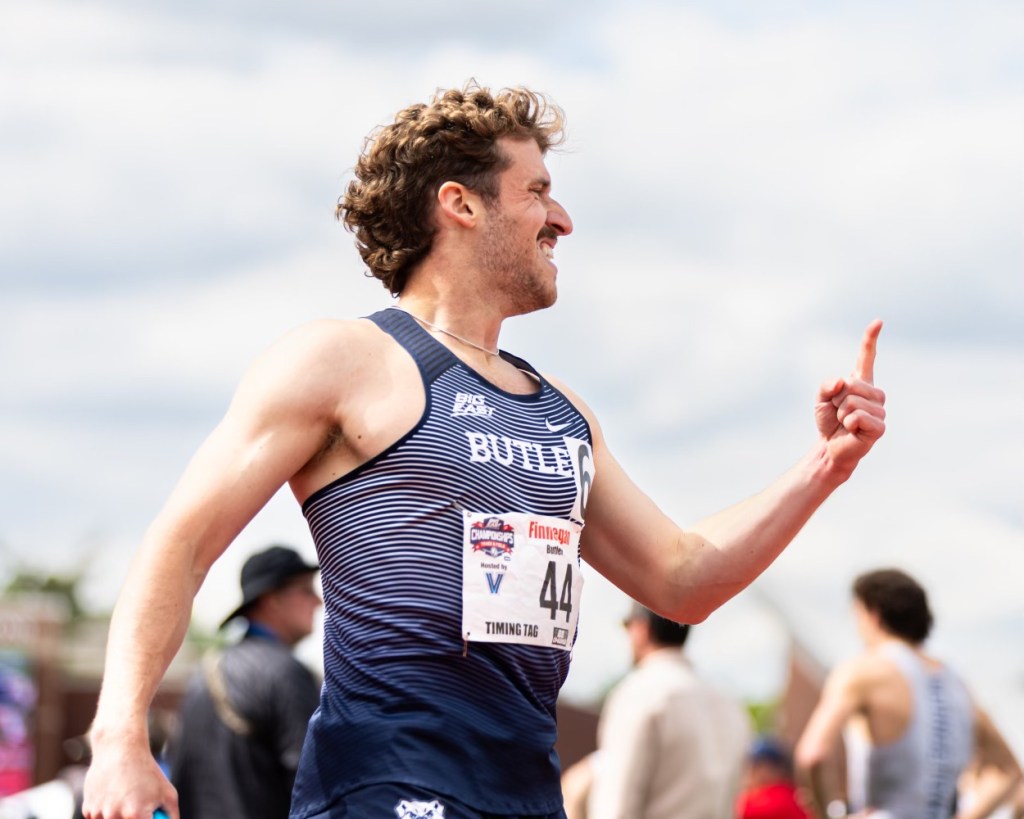
Luke’s 200-meter dash win at the 2022 MAC Championship and his anchor leg of the 4×400-meter relay in the Big East Conference Championship embody his competitive approach.
Regarding his 200-meter dash his senior year for Miami, he recalled, “I was nurturing a hamstring the whole year, and I just, I really—I blacked out. I don’t remember the race because I was running out of such anger that I just don’t give a damn. Like, if I get hurt, it’s my last race. What do I have to lose? And man, I’m just so glad that I did what I did there because it’s so memorable.”
Matched up against another athlete he’d been competing with since high school, Luke won the race by the slightest margin possible: .01 seconds. This personal best defines the sport. Years of training, preparation, and competition, just to be separated by .01 seconds.
Luke went all out, thinking it would be his last race ever, but little did he know, it was just the start of a new beginning. The race propelled him into Regionals and granted him the opportunity to race again as a graduate student, this time at Butler University, leading to another memorable win.
In his final collegiate race, he was the anchor in Butler’s 4×400-meter relay team at the conference championship. And just to add more fuel to his fire, running anchor for the team right on his back was an athlete who had a pretty viral social media post celebrating a win over Luke in the indoor season.
In the indoor race, Luke didn’t have his foot all the way on the gas because the team had secured second place in the meet, so going all out wasn’t worth risking injury. But in his final collegiate race after winning the 4×100-meter relay and the individual 200-meter dash, like his race in the MAC Championship, he had nothing to lose.
While Luke may have been “stone cold” for the majority of his races at Butler, this one was different, as he remembered, “This one I was nervous for a little bit. So, I knew the adrenaline was there.”
Luke recalled, “My third leg’s coming in, his third leg’s coming in, and I’m like, ‘We’re right where we want to be’… we get the sticks and I just go out as fast as I can.”
He had a gap on him at the 200-meter mark, but it wasn’t a huge lead. But between 200-300 meters in, it got closer, as Luke said, “I felt him and I’m getting weighed down a little bit, but I like to think of slingshotting off of that turn and into the straightaway.”
Luke remembered the pain he was in, “I heard his breath as I glanced at the Jumbotron at the 200m turn. I saw I had extended just a little more distance between us, and I knew it was time to put the race away…I’m in probably the most pain I’ve really ever been in, in track. And I’m just hauling and I’m just picturing him running next to me, like passing me.”
And when he crossed that finish line first and saw he ran it in 45 seconds all he could say was, “dayum!”
Some of Luke’s greatest races were won by thin margins. Margins earned when no one was watching, when he put in the extra hours, and when he grinded the extended training sessions.
His stone cold confidence was an assurance of his consistency. Come race day he knew what he was capable of. And he continued to prove it at the highest level.

 The Players’ Corner
Leave a comment