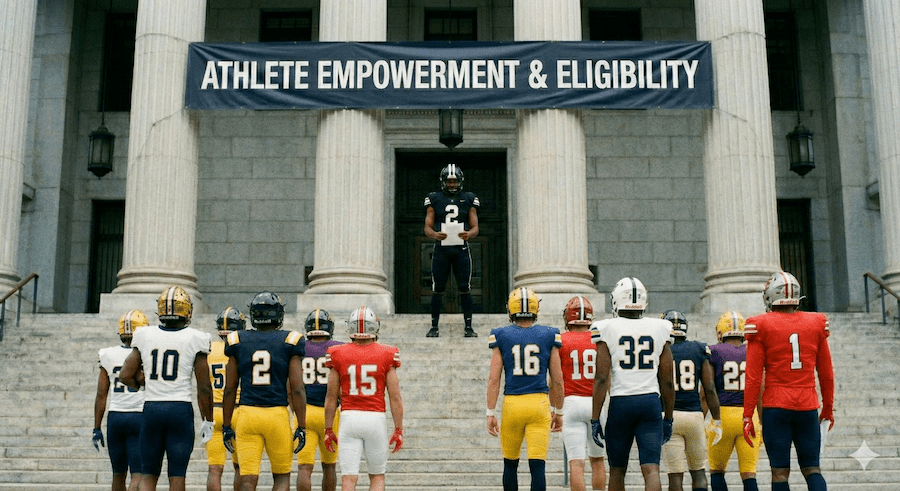
Diego Pavia: Heisman runner-up, Vanderbilt starting quarterback, and NCAA eligibility trailblazer.
Combining for over 4,000 yards through the air and on the ground, while totaling 36 touchdowns, Pavia’s Heisman-worthy campaign made him one of the biggest names in college football.
But this historic season almost didn’t happen. After playing 2 years of football at the junior college (JUCO) level and 3 years in the NCAA, Pavia’s eligibility was exhausted at the end of his 2024 season.
But rather than walk away, Pavia chose to fight the NCAA’s eligibility restrictions under antitrust law, and successfully earned himself another season.
Now, 26 former JUCO players are following Pavia’s lead and challenging the NCAA’s eligibility restrictions with a new lawsuit.
Pavia’s Path from JUCO to SEC
Diego Pavia’s underdog story captures the magic of sports. Pavia wasn’t a highly regarded recruit; he was an undersized quarterback with zero Division I offers.
Rather than pursue his Division II offers, Pavia began his collegiate career at New Mexico Military Institute (NMMI), a JUCO school. Even at the JUCO level, Pavia had to walk on and fight for the starting quarterback role during his first season.
Solidifying himself as the guy by the end of year one, Pavia had a standout year 2 season, where he won the JUCO national championship.
His play earned him a Division I offer at New Mexico State University, where he played the 2022 and 2023 seasons.
After earning Conference Player of the Year honors in his 2023 season, he followed his coach to Vanderbilt. This meant his college career, which began by walking on at a JUCO school, would end on the biggest stage: the SEC.
Under the NCAA’s bylaws, Pavia only had one remaining season when he transferred to Vanderbilt. The bylaws limit athletes to four seasons of competition within a five-year period. While JUCOs are not NCAA institutions, the time spent there counts against the 5-year window.
While Pavia had only spent 2 seasons in the NCAA at the time of his transfer, 4 years had been exhausted out of his 5-year window, meaning if he wanted to extend his time playing college football past the 2024 season, he’d have to file a lawsuit.
Embed from Getty ImagesPavia and the JUCO Players’ Lawsuits Summarized
In December 2024, the Tennessee Middle District Court sided with Diego Pavia, preventing the NCAA from enforcing eligibility restrictions on him for the 2025 season. Soon after, the NCAA granted a waiver to all JUCO players in the same situation as Pavia, allowing them to play in the 2025 season.
While Pavia was victorious in court, the court’s ruling did not have a universal impact; rather, the court’s decision was temporary and specifically applied to him.
However, the court’s decision forced the NCAA to react with a universal one-season waiver extending eligibility for JUCO players for the 2025-26 season. There are two main reasons why I believe the NCAA reacted with this.
First, Pavia won a preliminary injunction. For non-legal readers, what’s important to know is this: “[A] preliminary injunction is an extraordinary and drastic remedy, one that should not be granted unless the movant, by a clear showing, carries the burden of persuasion.” (Pavia at 535).
This meant the court believed that Pavia, the movant, established a sufficient likelihood he’d win if the case were presented for a final ruling. This signaled to the NCAA that courts would likely strike down their JUCO eligibility restrictions in future cases.
With this ruling, it’s likely that other players would have followed his lead and filed their own lawsuits against the NCAA for the 2025 season. The NCAA’s waiver prevented this flurry of lawsuits.
Secondly, the waiver allowed the NCAA to avoid litigation without permanently updating the bylaws. This bought the NCAA time, allowing it to build its case against the imminent lawsuits, evaluate the public reaction, and reconsider its restrictions.
Entering the 2026 season, this waiver is obsolete. And the imminent lawsuits are here. While reports are that Pavia is aiming towards the NFL, his legal legacy is as relevant as ever, as his argument gives a powerful basis for the 26 current plaintiffs.
It’s unknown whether the players will prevail in their current lawsuit, but Pavia’s case is an indication that they have a sufficient possibility of successfully challenging the NCAA’s bylaws.
Why Do Players Want to Return to College?
With the approval of NIL and increased monetization opportunities for college athletes, the upside in extra eligibility is greatly heightened.
To the NFL, Diego Pavia is an undersized, older quarterback who lacks the upside worth spending an early (or potentially any) pick on. This means he’d be signing a contract much closer to the league minimum ($840,000) than that of a franchise quarterback.
But to the NCAA, Diego Pavia is a dual-threat, mature quarterback that’s a sure-fire contender for the Heisman and a chance to compete in the College Football Playoffs. Before the 2025 season, Pavia was offered over $4 million to transfer.
The market reality for Pavia and many other college players is that their economic value after their college careers is significantly lower.
For example, look at Stetson Bennett. He went from winning national titles, appearing in national Canes ads, and his name being all over the media, to being a third-string NFL quarterback that rarely gets mentioned in headlines.
Alternatively, look at Treveyon Henderson. Many were surprised when he stayed for a final year at Ohio State rather than declare for the NFL. But by doing so, he produced a year full of highlights and played a major role in the national championship, leading to his early second-round draft selection.
Before NIL, it was much less likely that a player of his caliber would have returned to college. The NFL offered a chance at a payday, and college posed the risk of getting hurt. While the chance of injury remains, the opportunity to get paid is available in college now, and sometimes the pay is even higher than the pros.
Even the top college players lose their full influential power when the spotlight dims. One more season of eligibility means one more year of opportunity: a chance to improve draft stock, the leverage to grow a personal brand, and the upside of NIL monetization.
Embed from Getty ImagesWhat These Cases Mean for The Future
These lawsuits against NCAA eligibility signify much more than just 27 players getting one more season to play football. They represent the new landscape of college sports.
With NIL and the power of social media, college athletes have a unique opportunity to monetize their talent. Additionally, 98.5% of college football players won’t play professionally, and even some who do will lose some of their spotlight.
More than ever before, some players are better off extending their college stay rather than pursuing a professional path.
This is why lawsuits against the NCAA don’t stop at JUCO eligibility restrictions: a major push is happening for five years of eligibility for all players instead of redshirts, and former professional basketball players are going back to the college level.
The lawsuits show two major points: (1) there’s greater value than ever before in being a college athlete, and (2) the economic value presented to college athletes is often temporary.
While it’s a harsh reality, it’s a good reminder for college athletes: the window of market dominance could be temporary, so maximize it while you have it, and prepare for life after it.
Eligibility is opportunity, which is why Diego Pavia didn’t just win the ability to play another year of football; he trailblazed a path for college athletes to capitalize on their window of market leverage.
References
Pavia v. NCAA, 2024 U.S. Dist. LEXIS 228736, 1 (M.D. Tenn. Dec. 18, 2024).
Clarified Summary of New Junior College (JUCO) Eligibility Rules – 2025, https://eliteathletesrecruiting.com/2025/05/15/clarified-summary-of-new-junior-college-juco-eligibility-rules-2025/
Diego Pavia ESPN Statistics: https://www.espn.com/college-football/player/stats/_/id/5084180/diego-pavia
Diego Pavia transfer timeline: How Vanderbilt QB went from D-II to program legend in six years, https://sports.yahoo.com/articles/diego-pavia-transfer-timeline-vanderbilt-080000906.html
Estimated probability of competing in professional athletics, https://www.ncaa.org/sports/2015/3/6/estimated-probability-of-competing-in-professional-athletics.aspx
Former JUCO players are backing a legal move that could shift college football, https://www.si.com/fannation/college/cfb-hq/transfer-portal/former-juco-players-are-backing-legal-move-that-could-shift-college-football
Heisman Runner-Up Pavia Seeks Court Order to Keep Playing, https://www.sportico.com/law/analysis/2025/diego-pavia-heisman-trophy-nfl-draft-antitrust-lawsuit-ncaa-1234879881/
How Diego Pavia transformed Vanderbilt football, challenged NCAA, https://www.tennessean.com/story/sports/college/vanderbilt/2025/12/23/diego-pavia-vanderbilt-football-heisman-finalist-ncaa-junior-college-rule/87677694007/?gnt-cfr=1&gca-cat=p&gca-uir=false&gca-epti=z117457p119250c119250u002557d00—-v117457&gca-ft=49&gca-ds=sophi
NFL Salaries: What Is the Lowest Salary You Can Make in the NFL?https://www.profootballnetwork.com/nfl-salaries-what-is-the-lowest-you-can-make-in-the-nfl/
TreVeyon Henderson Announces Return For Senior Season, https://buckeyehuddle.com/2024/01/12/treveyon-henderson-announces-return-for-senior-season/
What Diego Pavia’s juco coach saw in his national title and how that matches Vanderbilt, https://sports.yahoo.com/article/diego-pavias-juco-coach-saw-100134684.html

 The Players’ Corner
Leave a comment