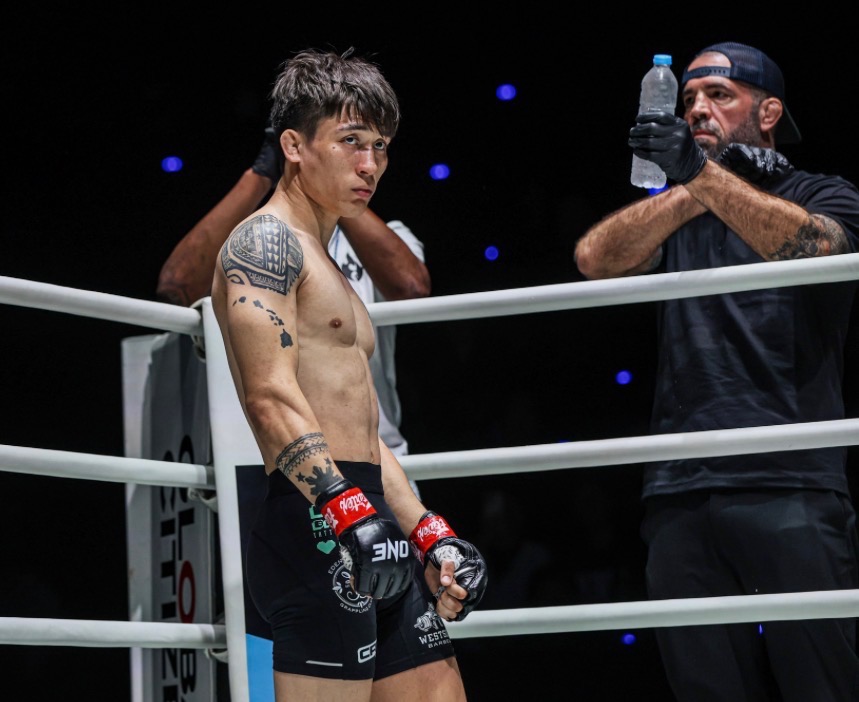
The horn had just sounded. After being on top of and striking Ahmad Bates’s face for over a minute, it was time for Joshua Perreira to return to his corner to rest before round two. But there was one last thing Josh had to do before heading back to his trainer: pick his opponent up.
To the average person, when they think of an MMA fighter, they think of a hyper-aggressive hothead. While undoubtedly, Josh has the ability and competitiveness to beat the greatest fighters, learning about and talking to him reveals a genuine humility that cannot be faked.
For a fighter whose story began in Kailua, Hawaii, and is now being written in Columbus, Ohio, Josh Perreira has felt the ultimate thrill, celebrating on the top of the ropes, but he’s also endured the most agonizing lows, lying in his bed, questioning his future. This is the story of the undefeated Flyin Hawaiian.
The First Fight: The Defining Moment
Josh is a lifelong martial artist…both formally and informally.
When he was younger, Josh wasn’t just fighting on the mats. He shared, “Growing up in Hawaii, I got into quite a bit of scraps. My brother used to call me Kimbo Slice.”
In the gym, Josh began with karate as a kid, then focused on judo in high school. Josh shared how, at that point, it wasn’t about having “dreams about being a mixed martial artist,” but rather “laying the foundation with all those different styles when I was younger and then slowly putting them together was pretty dang cool.”
But things shifted when his friend encouraged him to move to Ohio. After training like “Rocky [Balboa],” running around the Midwest in the snow, Josh took his first amateur fight…on a week’s notice.
Whether it was the short notice or the virus Josh caught running in the Ohio winter weather, Josh fell short in his first bout. But this was the defining moment in his career. He expressed, “There are so many different things that go into fighting, not just the striking. I was doing pretty good on the feet, but I didn’t know anything about wrestling or grappling just yet. And it lit a fire in me that, as you can see, still burns very, very bright.”
He might’ve been knocked down early as an amateur, but it’s what allows him to showcase an undefeated professional record.
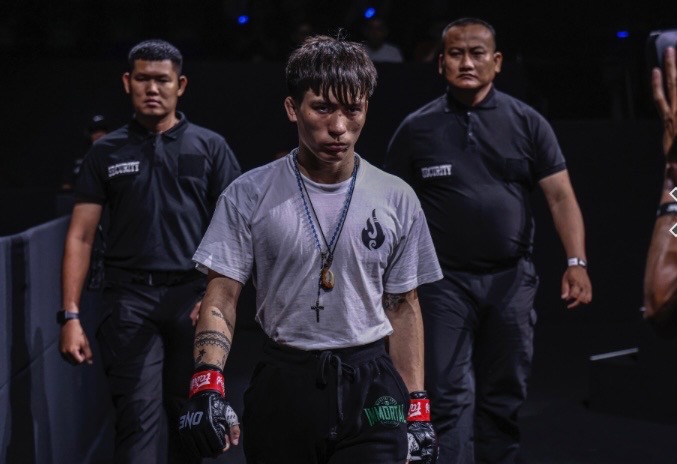
The Role of Emotions: Josh’s Calm Approach
He’s not boastful. He doesn’t let emotions take over his fights. His control is his strength, and his respect for others grounds him.
This approach traces back to his childhood, as Josh shared, “I grew up making sure that before anything happens, I put myself into other people’s shoes.”
It’s a guiding principle that makes him a perfect role model for the kids and young adults he trains. And it’s what encourages him to help others, because “nobody has any idea what everybody’s going through. So if I can just be a little light in a very dark room for somebody, just for that split moment, I’d be cool with that.”
This philosophy translates to how he treats his opponents. It’s why he’ll help his opponents up and why he hugs them after fights. He said, “Everybody works so hard. I train so hard, I can only imagine what everybody else is going through and training and the emotions that [it] takes… Yeah, it’s a very violent sport, but he’s not my nemesis; he’s not my enemy. It’s a job.”
But don’t take his kindness for weakness. In reality, it’s a power, as he revealed, “Whenever you fight with your emotions and not technique, you tend to rely on power, or you tend to rely on just trying to take their head off. When you rely on that, the technique goes out the window.”
He specifically shared how he takes advantage of an emotional opponent: “They leave holes open; they leave opportunities to get countered, opportunities to get taken down. When people are fighting with emotions, they usually have certain tendencies—maybe they’ll kinda like grit their teeth and bring their hands down before they swing, which is a great opportunity for me to take advantage of that.”
Instead, Josh believes, “You gotta be cold. You gotta be calculated. You gotta be able to see things happen. And when you have blinders on, when you’re so very angry, it’s hard to see the shots that come around the guard.”
In a sport where adrenaline rushes, it’s not the fighter relying on emotions who wins. It’s the fighter with control.
The Banma Fight: The Agony
Walking into the ring on ONE Fight Night 29, Josh was coming off the best training camp of his career. In his first fight since signing with one of the biggest MMA organizations in the world, Josh was ready to showcase his ability on the international stage in a bout against Banma DuoJi.
But less than a minute into the fight, the momentum he had built in training camp and with five straight professional wins vanished. He shared, “I stepped forward on a jab the same way that I’ve thrown a jab thousands of times in sparring and in fights. And I felt a stinging sensation in my knee, as if somebody had put a piece of metal between my kneecap and my bone.”
The stinging sensation was the result of a torn ACL. But for over a minute, Josh continued to battle in the cage, even tackling Banma seconds after the injury. In the end, battling on one knee, he came up short.
While he immediately wondered: “What did I do wrong? What was that? Why is my knee like this? What’s my family thinking? What’s my team thinking?” The real pain didn’t set in the ring.
Josh recalled the moments when the adrenaline subsided, “Going back home, I remember sitting on the edge of the bathtub, using a washcloth to wash myself off….Crying, lying in bed, just awful. I hope nobody ever gets to feel that.”
After months of an inability to perform routine tasks like showering and walking up stairs, Josh rethought his career. He confessed, “I was thinking about quitting. I thought I was gonna be done.”
But he thought about his teammates who’ve battled back from injuries. And so many others who deal with setbacks every day. So he went to rehab. He remembered, “As soon as I was able to walk, I was boxing. As soon as I was able to run, I was kickboxing. And as soon as I was cleared, I was back to grappling and everything. Just don’t tell my surgeon.”
For 13 months, Josh rehabbed his knee, and it was all because of a fight that resulted in a no-contest. A couple of weeks after the fight, Josh got a message from a personality with ONE Championship…Banma tested positive for banned substances.
While it meant Josh was once again undefeated, he was far from satisfied. The fight just didn’t sit right with him: “I wish I had lost decisively. I wish I had lost with a knockout, a sub, or even just a unanimous decision. [I] kind of felt robbed because not just the injury, but he was cheating as well.”
With reflection, it made Josh’s passion burn deeper, as he expressed, “That kind of lit a fire in me, like, shoot, that guy had to take those to fight me. I gotta get back to work.”
The Nakatani Fight: The Thrill
13 months later, Josh had a new opportunity. A second fight with ONE Championship, this time against Gilbert Nakatani.
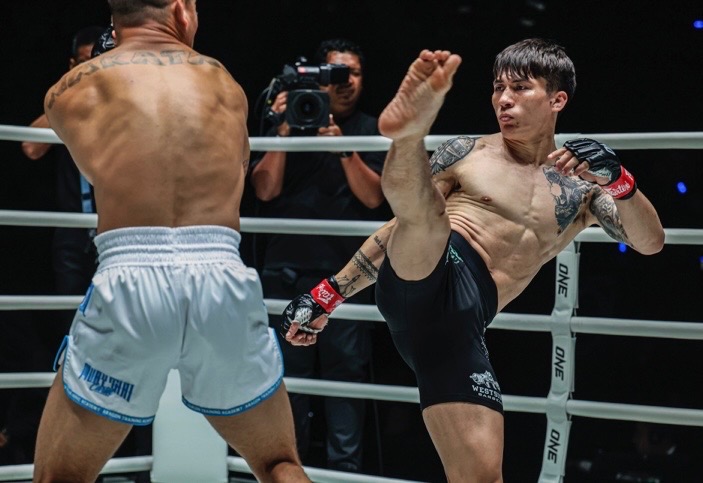
He anticipated that Nakatani would target his greatest vulnerability, his right knee. So when Nakatani came out in southpaw (his right hand and right foot in front), Josh was ready.
Josh quickly analyzed Nakatani’s tendencies and recognized that Nakatani lunged and brought his hands down after one of his kicks. Within the first thirty seconds, Josh threw a few kicks, landing a big one, while also landing a left-handed strike. This laid the foundation for his trap.
Josh threw one more kick at Nakatani with his right foot, and when he threw the kick, Nakatani’s coach yelled ‘go,’ and Nakatani lunged in. But Josh’s back being turned to Nakatani after the kick wasn’t a moment of opportunity for Nakatani. Josh had thrown the kick as a fake, understanding Nakatani would lunge in. When Nakatani lunged, Josh stepped through and knocked him out with a backfist as he spun.
Less than a year prior, Josh couldn’t walk. But in just 38 seconds, he earned his time celebrating on the top ropes. This time, “the emotions surged.”
Fans saw a 38-second fight. But they didn’t see the 421 days of preparation it took to get there. It wasn’t easy. Josh shared, “I trained so very hard.”
He had even more to give than what he showcased in those 38 seconds, but that just makes him “even healthier for the next one.”
The Supporting Team: The Anchor
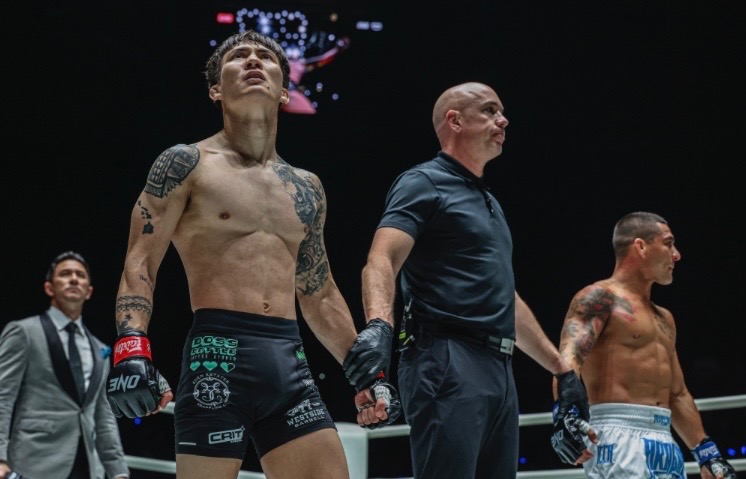
Whether he’s celebrating a 38-second knockout win, eating fried chicken, or lying in his bed immobile, Josh doesn’t fight alone. He has a community behind him at his gym in Columbus, Immortal Martial Arts Center. He has coaches, teammates, and sponsors who back and support him.
And he has a fiancée who’s there for him at his toughest moments. Josh remembered, “[When] my car broke down, she put her life on hold to get me to where I needed to go because she believed in me.”
Josh recognizes it’s a team effort: “I started with literally nothing. And if it wasn’t for all of those little moving parts of this greater machine, I wouldn’t be where I’m at now.”
A professional MMA fighter who, through respect, control, and pure grit, has reached the top ropes. That is Joshua Perreira; that is the Flyin Hawaiian.




Leave a Reply